
Lamar Deed Types Explained
A deed records a conveyance once it is presented to the Clerk. Its legal effect depends on the instrument. Read the language before calling it a sale. Security deeds and liens sit in the same broad real-estate records system, yet neither works as a fee-title conveyance of the property.
| Deed Type | What It Does | Common Use |
|---|---|---|
| Warranty deed | Conveys the stated interest with warranties in its text | Arm's-length transfers |
| Quitclaim deed | Conveys whatever interest the grantor has | Interest cleanup or family transfer |
| Executor or trustee deed | Conveys through a stated fiduciary capacity | Estate or trust property |
| Tax deed | Records a transfer tied to a tax-sale process | Delinquent-tax property |
| Security deed | Secures debt against real property | Financing, not a sale deed |
The granting clause, party capacity, legal description, exceptions, and clerk stamp carry the operative language. Index lines only find the image.
Lamar Grantor-Grantee Chain
The GSCCCA Real Estate Index is the chief remote search. Select Lamar County first. Start with the current owner of record as grantee and locate that party's acquiring deed. Then search each prior grantor as a grantee. That walks the chain backward. Follow the property description and cross-references rather than names alone.
- Find the newest matching acquiring deed with the current party as grantee.
- Copy the grantor, recording time, type, book/page, and legal description.
- Search that grantor as a prior grantee and match the same land.
- Repeat until the online range ends, then ask for older deed-book access.
- Grantor
- The party conveying an interest.
- Grantee
- The party receiving the stated interest.
- Chain of title
- The linked sequence of conveyances for the same land.
- Book/page or instrument number
- A filing reference used to retrieve the record.
Obtain a Lamar Deed Copy
GSCCCA sometimes makes an online image available under its active service rules. Start there. Save every page needed to read the description, signatures, exhibits, plat references, and clerk stamps. Image and account access vary by service level. No exact charge for each historical book is published.
For a plain or certified copy, contact the Clerk of Superior and Juvenile Court at 326 Thomaston Street, Barnesville, GA 30204, or 770-358-5145. Weekday hours run 8:00 a.m. to 5:00 p.m. Give the party, recording date, book/page or instrument number, and copy type, then confirm the current fee before ordering.
Recorded, not guaranteed. Lamar deed records show filings accepted for record. They are not a title opinion, and unrecorded interests may exist.
Search Fields for Lamar Deeds
The statewide index offers several search paths for Lamar deeds.
| Field | Useful entry | Search decision |
|---|---|---|
| County | Lamar County | Start county-only to reduce false matches |
| Party role | Grantor, grantee, borrower, lender, trustee | Use the actual role label |
| Name | Legal spelling and variants | Test initials, suffixes, trusts, estates, entities |
| Date range | Known transfer window | Start narrow, then expand |
| Instrument type | Deed, security deed, release, plat, lien | Keep conveyance and encumbrance searches distinct |
| Property detail | Subdivision, unit, lot, block, land lot | Match land, not just a party name |
GSCCCA's official description confirms name, property, book/page, county, date, instrument, and geographic modes. Some functions and images require an account. Save the filter set so another researcher can repeat any query.
Match Lamar Legal Descriptions
The index standards cover many fields. Land lot, district, section or GMD, subdivision, unit, lot, block, comments, and cross-references all appear. Rural acreage calls for comparing the road, tract size, land lot, district, and metes-and-bounds calls. Platted land works differently. Compare subdivision, unit, lot, block, plat book/page, and any later replats.
A deed saying "being the same property conveyed by" is a direct path backward. It points to an earlier book/page. Follow it anyway. qPublic may show a new parcel number. When an instrument says "less and except," the excluded tract matters. Compare it and each cited plat before carrying the acreage backward.
Lamar Plats Support the Chain
The GSCCCA Plat Docket supports several search angles. County, plat name, book/page, and instrument type all work. Pull the recorded image and note the title, filing date, surveyor or engineer, lot and block labels, easements, rights-of-way, and restrictions. A plat can explain a lot split or road line that a deed describes only by reference.
Compare the recorded plat with the current tax-map polygon. Keep their legal roles separate. A tax parcel can differ from a recorded lot or a later replat, and boundary certainty may take a licensed surveyor.
Note: Parcel identifiers are search keys and should never replace the recorded legal description of the property.
Lamar Security Deeds and Releases
A security deed creates a recorded collateral interest, not a fee-title transfer. Search it separately. Warranty, quitclaim, executor, trustee, and tax deeds each deserve their own pass. Then track assignments, cancellations, and releases tied to the original filing.
Match borrower and lender roles first. Add the filing date, book/page, property description, and referenced prior instrument. One release does not clear every lien. Search the lien docket, tax executions, and relevant judgments as distinct record groups.
Pre-1999 Lamar Deed Research
GSCCAA states that its statewide deed index covers all Georgia counties from at least January 1, 1999. Older history is added over time. Lamar's earliest complete index year is unstated. Treat that gap as open, not as a cutoff. Take the last reliable book/page to the Clerk. Ask which prior index, deed book, microfilm, or image series continues the chain. The Georgia Archives county-card collection can identify county creation and courthouse-record context. It does not list complete Lamar microfilm holdings. Lamar was formed in 1921 from parts of Pike and Monroe counties. Earlier land evidence may sit in predecessor county deed records.
Historic Lamar Deed Leads
The Herald-Gazette archive is a searchable local legal-organ lead. Its Barnesville weekly collection runs 1981-current and traces roots to the Weekly Gazette founded in 1868. Search by party, road, or subdivision. Legal notices, foreclosures, tax sales, and rezonings appear too.
A March 11, 2025 notice shows the method. It names a security deed, deed book/page, land lot, acreage, and courthouse-sale date. Those facts are only leads; confirm each against the recorder, tax, and court sources before adding it to a chain.
Resolve Lamar Name Variants
A Lamar County deed index search can stall on small name problems. Initials are a common trap. So are suffixes, married names, misspellings, estate language, and trustee capacity. Entity forms trip up searches too. Run exact and variant spellings while holding the property description constant, then record the indexed spelling exactly as the clerk entered it rather than quietly fixing it. For an LLC, the Georgia Corporations Division search confirms the legal entity name, control number, and registered-agent context. That source cannot prove which land the entity owns. The deed and its legal description still control.
FANS Alerts for Lamar Filings
Lamar County links Georgia's free Filing Activity Notification System. FANS sends email or text notice whenever a registered name shows up in a property, lien, plat, or personal-property filing. It beats rerunning the full index daily. Still, an alert is not a title search. Common names produce false matches, and spelling differences can let a filing slip past entirely. Register every relevant variant. Then open the docket entry itself and verify what it actually says.
Note: Treat each FANS notice as a lead only, and keep the official recording details from the Clerk or GSCCCA.
Build a Lamar Deed Worksheet
Give every conveyance its own row. That single habit keeps a long deed chain in order. It stops the chain from collapsing into a bare list of names. For each row, record the filing date and time, plus the instrument type. Record each grantor and grantee exactly as indexed. Add the book/page or document number, consideration when shown, and a legal-description summary. Note the parcel or tax-map clue, plus plat and easement references. Add the image-page count and source URL too.
Leave room for a conclusion field. Use it for unresolved differences. Maybe the acreage changed, or a spouse vanished from the next deed. Maybe a parcel split intervened, or an estate transfer needs probate evidence. A worksheet cannot certify title. It does make the reasoning reproducible, and it shows exactly where office help is needed.
Lamar Recording Standards Matter
GSCCCA indexing standards cover grantors, grantees, instrument type, filed date and time, book, page, and general description. They also cover land lots, districts, sections or GMDs, subdivisions, units, lots, blocks, comments, and cross-references. Field labels can differ in the live system. So preserve its displayed text, and consult the GSCCCA's official real-estate index guide for the full standard.
Index fields only locate a filing. They never replace the instrument itself. The search guide helps identify supported queries. Still, the instrument image and Clerk citation remain the evidence, so read every image page needed to catch exhibits, signatures, clerk stamps, exceptions, and prior-record references. If an image is not accessible, give the Clerk the precise index citation rather than guessing from the result line.
Lamar Deed Index View
The GSCCCA Real Estate search provides the statewide deed-index entry shown below.
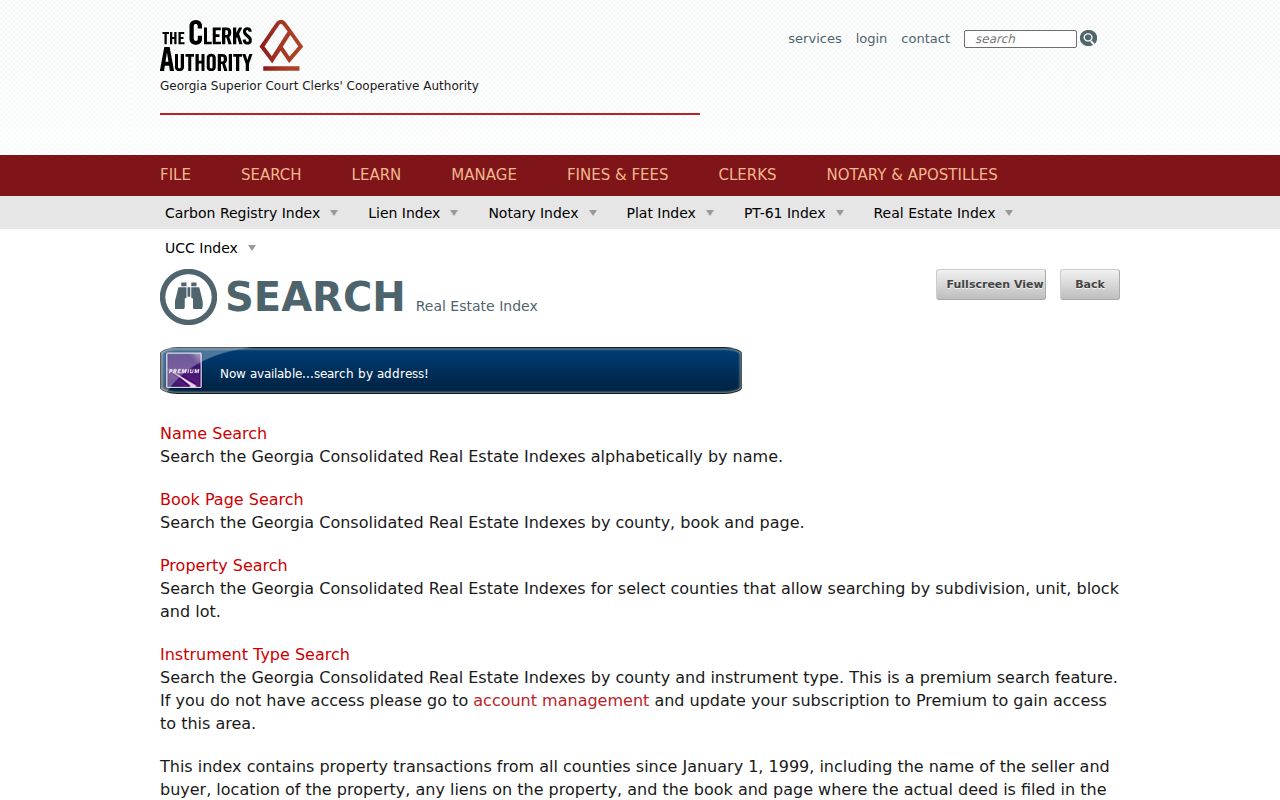
Select Lamar County in the index. Then preserve each party, date, and instrument filter before adding a result to the deed chain.
Estate and trust conveyances need extra care. Preserve the capacity attached to every party name. An executor, administrator, or trustee may sign under authority that lives outside the deed index. Note any related probate or court reference. Do not assume that reference transfers the land by itself; the recorded deed still has to match the same Lamar legal description.
Every deed-chain conclusion should state two things. Say what is settled and what stays open. Identify the newest verified grantee, the oldest online link reached, each unresolved gap, and the exact book, page, plat, or office request needed next. That record keeps a historical search honest when images, older indexes, or cross-referenced exhibits are unavailable.