
Identify a Lamar County Owner
Owner research in Lamar County follows a short chain of evidence. An address leads to an assessor parcel. The parcel record supplies the displayed NAME field and the parcel number. The newest recorded deed then confirms the grantee. Let each record do its own job. A recent sale can leave the assessor roll behind the deed index.
- Search the situs address in Lamar qPublic. Copy the account, parcel number, displayed name, mailing field, and current result date.
- Match the map shape and legal-description clues so a similar address or road name does not lead to the wrong parcel.
- Search Lamar County in the GSCCCA Real Estate Index for the displayed name as grantee, then check the latest deed image or Clerk record.
- If the grantee is an entity, preserve the exact entity name and use Georgia's business search only for entity context, not as a substitute for the deed.
Record both sources and both dates. When they disagree, remember that the assessor roll is a tax snapshot while the later recorded instrument carries the actual conveyance evidence.
Lamar County Owner Fields
The Lamar qPublic portal is the starting point for county parcel data. Its parcel card uses fixed field labels. An official county returned-notice sample shows several of them exactly: NAME, MAILADDR, PARCEL NO, Situs, Account No., plus value and homestead fields. Quote those labels as displayed. The NAME field is not guaranteed legal title. Situs gives the property's physical address.
MAILADDR shows where assessment mail goes, and the two can differ for perfectly valid reasons. A mailing address proves nothing about residence. The displayed name may belong to an individual, an estate, a trust, a business, or another recorded interest. Open the current Lamar County parcel source to pull a parcel-specific record.
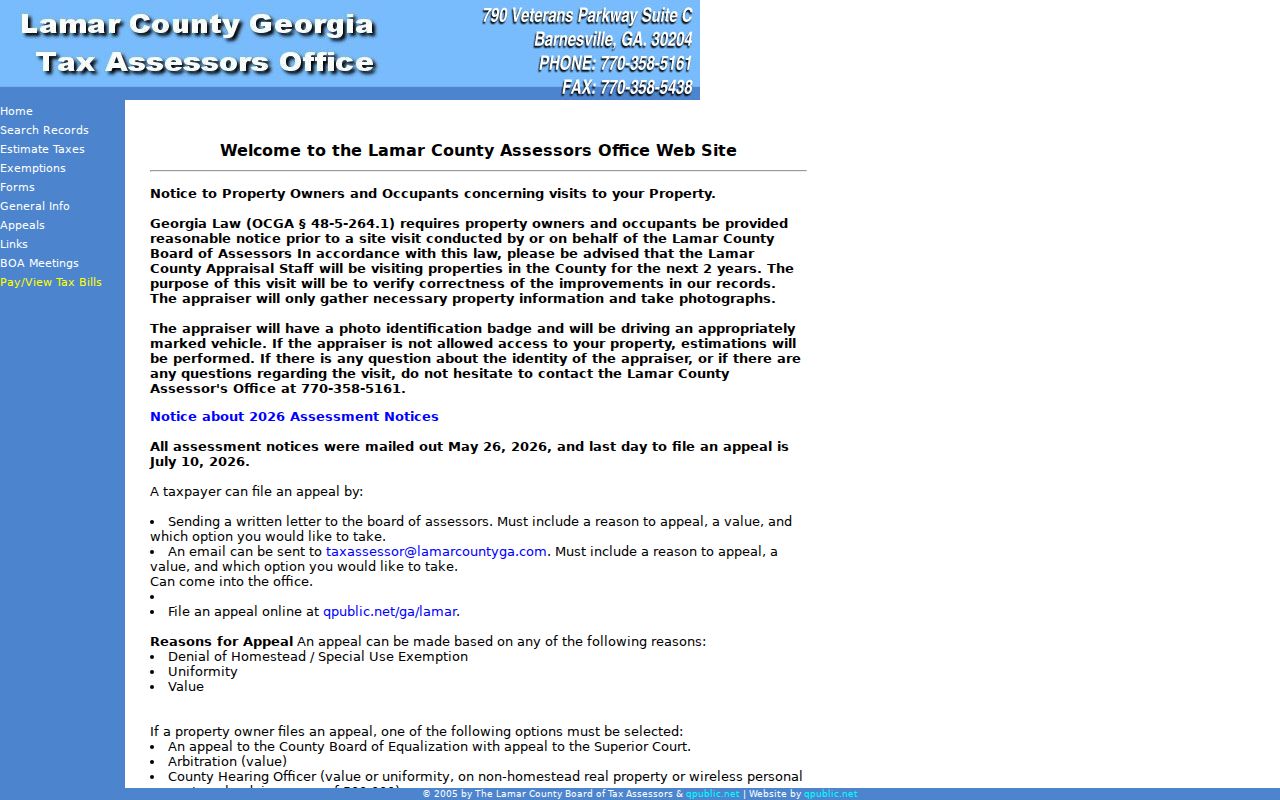
The image shows the assessor gateway itself. Naming an owner for a particular parcel still takes an address search and a dated result.
Lamar County Ownership Sources
Several Lamar County records can name an owner. Each one answers a different question, though. The assessor roll identifies the current tax account, while a deed identifies the grantee in a recorded conveyance. A parcel map ties the account to geography, and state business records add context when the grantee is an entity.
| Source | Owner Info It Gives | Access |
|---|---|---|
| Lamar qPublic roll | NAME, mailing and situs fields, parcel and account keys | County-linked portal; live access may fail |
| GSCCCA deed index | Grantee, grantor, instrument, recording date, book and page | Statewide index; image and account rules vary |
| Clerk of Superior Court | Recorded deed, plat, lien, and older-book assistance | Counter and telephone fallback |
| Georgia business search | Entity name, status, registered agent, and listed officers where shown | State entity context |
| qPublic map | Parcel shape and nearby parcel identifiers when available | Reference map, not a title source |
Occupants and mail recipients are not always grantees. A deed can convey only a partial interest, create a life estate, or vest title in trustees. Read the vesting language. Assuming the first name in a search result owns the whole tract is a common and costly mistake.
Confirm Lamar Owners by Deed
The Real Estate Index from GSCCCA comes into play once the assessor has given you a name and parcel clues. Limit the first search to Lamar County. Run the displayed person or entity as grantee. Narrow the date range. Inspect the newest likely conveyance and record the instrument type, filing date and time, grantor, grantee, book and page, legal description, parcel or tax-map reference, and any plat cross-reference.
Match the deed by more than a name. Situs, acreage, land lot and district, subdivision, lot and block, or a plat reference all work. A same-name result may involve other land. A security deed is not a fee transfer at all; it documents secured debt and belongs in its own search.
Images of older instruments can be unavailable. In that case, contact Clerk Caleb Tyson's office at 326 Thomaston Street in Barnesville, or call 770-358-5145. The Clerk records real estate, plats, liens, and UCCs and serves as the authoritative local fallback.
Recent Lamar County Sales
Lamar County publishes no verified schedule for how fast qPublic updates after a deed is recorded. That leaves a practical gap around a recent closing. Preserve the qPublic result date. Preserve the deed's recording date too. Then ask the Tax Assessor whether the roll has refreshed, and keep both pieces of evidence even when the names differ.
A mismatch can reflect a normal update lag. It can also reflect estate or trust wording, a partial interest, a clerical spelling, or an instrument not yet found. Neither office has necessarily made an error. When the answer turns on who is shown right now, the current Lamar County owner record deserves a closer date comparison.
Note: A deed's recording date and an assessor roll date answer different timing questions; save both in every recent-sale review.
Lamar Property Owned by Entities
An LLC or corporation changes the routine. Search the entity name exactly as written. The Georgia Corporations Division Business Search handles entity-name and control-number lookups. It may show status, registered-agent, and officer details. Those details help separate businesses with similar names. Business filings do not move title, however.
The company stays the named property owner until a later recorded instrument says otherwise. A registered agent is a contact point, not automatically the beneficial owner of the entity's land. Trusts and estates deserve the same discipline: record the exact capacity, inspect the deed, and check probate or court files only when the ownership trail calls for it.
- Owner of record
- The name displayed in an official roll or recording source at a stated date.
- Grantee
- The person or entity receiving the interest described by a deed.
- Title
- The legal rights in land; a name lookup alone is not a title examination.
- Situs address
- The physical location of the parcel, which may differ from its mailing address.
Older Lamar Ownership Trails
Georgia's statewide deed index reaches back to January 1, 1999 at minimum. That coverage comes from the GSCCCA. Older material enters at uneven depths. The earliest Lamar County books are not guaranteed online. A complete set of historic images is not guaranteed there either. When a deed falls before the available results, call the Clerk. Ask about older indexes, deed books, images, copies, and certification.
Lamar County formed in 1921. A chain reaching before that year may branch into a parent county's records. Search historic tracts by land lot, district, road name, and legal description. Georgia Archives county cards help point the way. Local historical sources work as finding aids too. But an archive reference only points toward a record; the certified deed remains the proof.
When Lamar Owner Search Fails
A blocked qPublic page signals an access problem, not a missing owner of record, so try the county's home entry first. Then test exact and shortened addresses, street-only searching, the parcel ID, and map navigation. Match the spelling and road suffix shown in the Situs field, because rural parcels may carry a route number or postal city outside the municipal jurisdiction.
Divide the work by office. The Clerk holds the deeds. The Tax Assessor keeps the tax roll. When a county-held file lacks an index, send a focused request to the Lamar County Open Records Officer naming the parcel, address, date range, record type, and preferred electronic format. The county charges ten cents per regular page. Georgia law permits labor charges after the first fifteen minutes.
Limits on Lamar Owner Lookups
An owner lookup has firm limits in Lamar County. It cannot prove occupancy or expose every beneficial interest behind a trust or entity. It settles no boundary and no title question. It also must not be mixed with election records to infer ownership; Georgia's My Voter Page handles registration rather than land title, and VoteSafe protects participants' address data.
Lawful use. Use Lamar County property owner records for legitimate due diligence, boundary, estate, or civic research. Never use public details to stalk, harass, intimidate, or harm anyone.
A recorded name is only a lead. Keep the source and the access date. For earlier owners, the Lamar County former-owner trail follows the deed chain backward rather than treating today's assessor name as a complete history.